A crystal-clear, ecologically stable aquarium is the dream of every aquarium enthusiast. Behind this dream almost always lies an indispensable key piece of equipment – the filter. It’s like the “kidneys” and “lungs” of the aquarium, responsible for removing waste and maintaining water quality. Faced with a dazzling array of filters on the market, how do you choose? This article will guide you through the principles, advantages, disadvantages, and applicable scenarios of all mainstream filters.
Why Does an Aquarium Need a Filter?
In natural waters, the water volume is vast and has self-purifying capabilities. However, in the confined space of an aquarium, fish excrement, leftover food, and organic waste quickly decompose, producing highly toxic ammonia. The three core tasks of a filter are:
1. Mechanical Filtration: Physically intercepts solid waste in the water, such as feces and uneaten food, keeping the water clear.
2. Biological Filtration: This is the soul of the filtration system. 1. **Nitrifying Bacteria Filtration:** Utilizing filter media (such as ceramic rings and bio-balls) to provide a large surface area, nitrifying bacteria can colonize and convert toxic ammonia and nitrite into less toxic nitrate.
2. **Chemical Filtration:** Utilizing special filter media such as activated carbon and adsorbent resins to remove pigments, medications, odors, and harmful chemicals from the water.
A highly efficient filtration system must simultaneously incorporate mechanical and biological filtration, supplemented by chemical filtration when necessary.
—
Mainstream Filter Types Explained
1. **Top Filter:**
· Working Principle: Water is pumped to the top of the aquarium by a submersible motor. The water then flows naturally through the filter media under gravity and returns to the aquarium like a waterfall.
· Advantages:
· Affordable and easy to get started with.
· Very convenient to clean and replace filter media.
· Effectively disperses water on the surface when the water flows back into the tank, bringing a large amount of dissolved oxygen to the aquarium.
• Disadvantages:
• Poor aesthetics, with exposed pipes and filter tank.
• Potentially loud water flow noise.
• Limited biological filtration capacity due to filter tank space constraints.
• Suitable for: Beginners, small to medium-sized aquariums, and fish with high waste production such as goldfish.
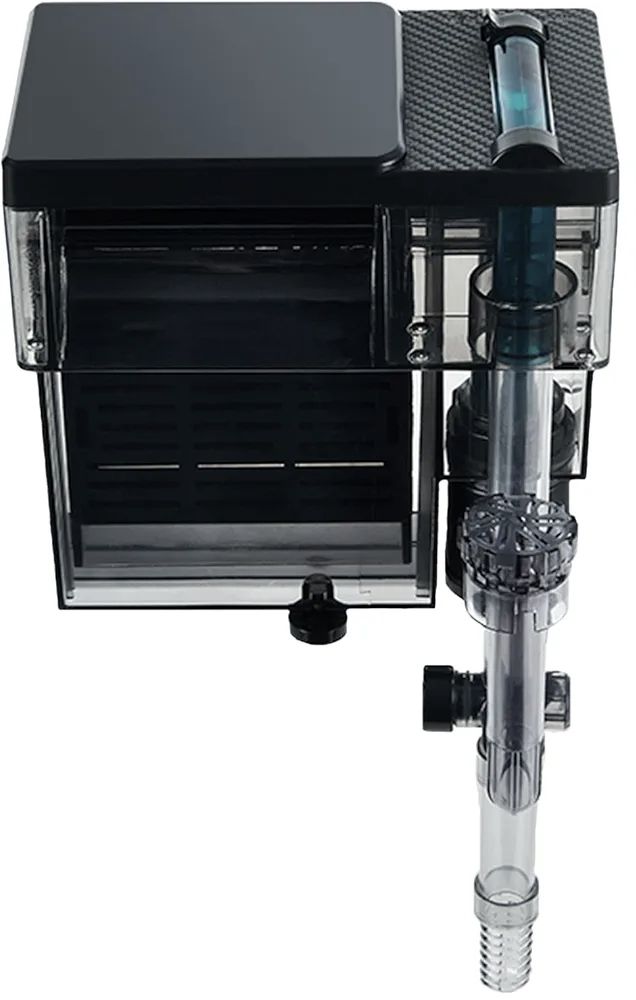
This 6W aquarium filter offers a 150 GPH flow rate, making it ideal for 10-40 gallon aquariums.
Product link
https://amzn.to/4831T8D
2. Submersible Filter (Built-in Filter, Submersible Filter)
• Working Principle: The entire device is completely submerged in water. A built-in motor draws water, forcing it through the filter media inside the unit before discharging it.
• Advantages:
• Very quiet, easy to install.
• Inexpensive, doesn’t take up external space.
• Creates water flow, preventing stagnant areas.
• Disadvantages:
• Takes up internal space, may affect aquascaping.
• Biological filtration capacity is usually weaker.
• Cleaning requires removing the entire unit, which can easily disturb the bottom of the tank.
• Suitable for: Small fish tanks, shrimp tanks, as supplementary water flow or backup filtration.
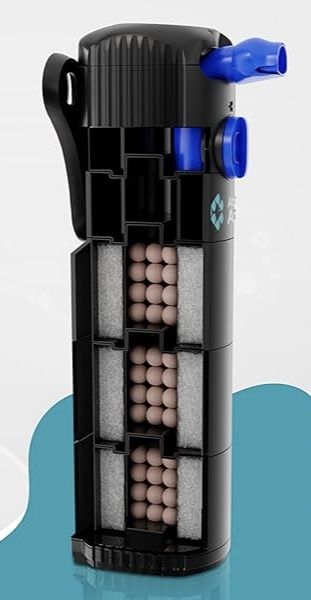
Submersible aquarium filters include sponge filters and biological filters.
Product link
https://amzn.to/4m2uSwI
3. Canister Filter (External Filter, Round Canister)
* **Working Principle:** Completely independent of the aquarium, typically placed in a cabinet. Connected to the aquarium via inlet and outlet hoses, a powerful motor draws water into the canister, pressurizes it, and allows it to flow through various filter media in multiple filter baskets before returning it to the aquarium.
Advantages:
* **Extremely high filtration efficiency and excellent quiet operation (the main unit is inside the cabinet).**
* **Large filter media capacity, providing the most powerful and stable biological filtration.**
* **Does not take up external space in the aquarium, resulting in a neat and aesthetically pleasing appearance.**
Disadvantages:
* **Relatively high price.**
* **Cleaning and maintenance are more complicated, requiring power disconnection, hose disassembly, and moving the canister.**
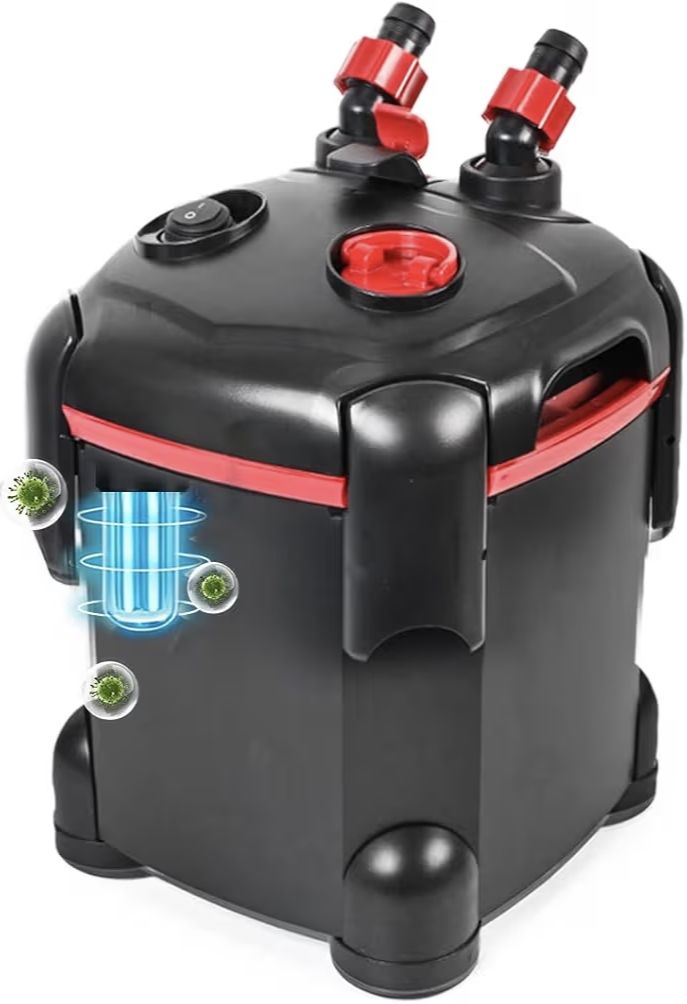
* **Suitable for:** Medium to large aquariums, planted aquariums, sensitive fish species requiring extremely stable water quality, and intermediate to advanced aquarists. 4 noise-reducing rubber feet for maximum noise minimization
Recirculates up to 265 US gallons/hour of water
UV sterilization lamp can be installed
Product link
https://amzn.to/47zrshG
4. Sump Filter
• How it works: This is the most powerful filtration system. The main tank has a hole at the bottom (or an overflow channel) connecting to the sump filter below. Water automatically flows to the sump, passes through a series of zones (such as dry/wet separation, algae tank, and media zone), and is then pumped back to the main tank by a powerful motor.
• Advantages:
• Unparalleled filtration capacity, significantly increased water volume, and most stable water quality.
• All equipment (heater, protein skimmer, etc.) can be concealed in the cabinet, resulting in an extremely aesthetically pleasing main tank.
• Fully customizable media configuration and water flow path.
• Disadvantages:
• Most complex design and installation, highest cost. • Takes up cabinet space and poses a risk of leakage (requires careful planning and management).
• Suitable for: Large aquariums, saltwater aquariums, arowana aquariums, and serious aquarists.
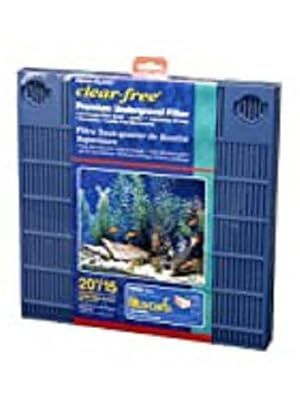
This filter is suitable for most 15-20 gallon aquariums. Biological, chemical, and physical filtration.
Product link
https://amzn.to/42bD3Qi
5. Other Specialized Filters
• Sponge Filter (Sponge Filter): Uses rising air bubbles to create suction, drawing water through the sponge. Large surface area for bacterial growth, gentle on juvenile fish, often used as supplementary filtration or in breeding and treatment tanks.
• Drip Filter: An enhanced version of top filters, water drips like rain through multiple layers of filter media, resulting in extremely high dissolved oxygen efficiency and amazing biological filtration, but with more noticeable aesthetic and noise issues.
—
How to Choose the Most Suitable Filter?
You can make your decision based on the following points:
1. Tank Size and Biomass: The larger the tank and the more fish, the stronger the required filtration efficiency. Small tanks can choose built-in/hung-in filters, while large tanks are best suited for canister or sump filters.
2. Keeping Goals: Planted tanks require stable biological filtration (canister filters), breeding tanks require gentle water flow (sprite filters), and saltwater tanks require extreme filtration capabilities (sump filters).
3. Budget and Ease of Maintenance: Consider your equipment budget and your willingness to perform frequent maintenance. Canister filters, which require frequent cleaning, may not be suitable for lazy aquarists.
4. Aesthetics and Quiet Operation: If you prioritize a clean and quiet environment, canister and sump filters are the best choices.
Conclusion: There is no “best” filter, only the “most suitable” filter. Understanding the characteristics of each filter and combining them with your own needs will allow you to create a clear, healthy, and perfect home for your beloved aquarium pets. Remember, a powerful filtration system is the most reliable investment on the road to successful fishkeeping!
Hopefully, this article helps you make an informed choice! Happy Fishkeeping!


 Site Title
Leave a comment